
Security Lighting That Protects Without Glare
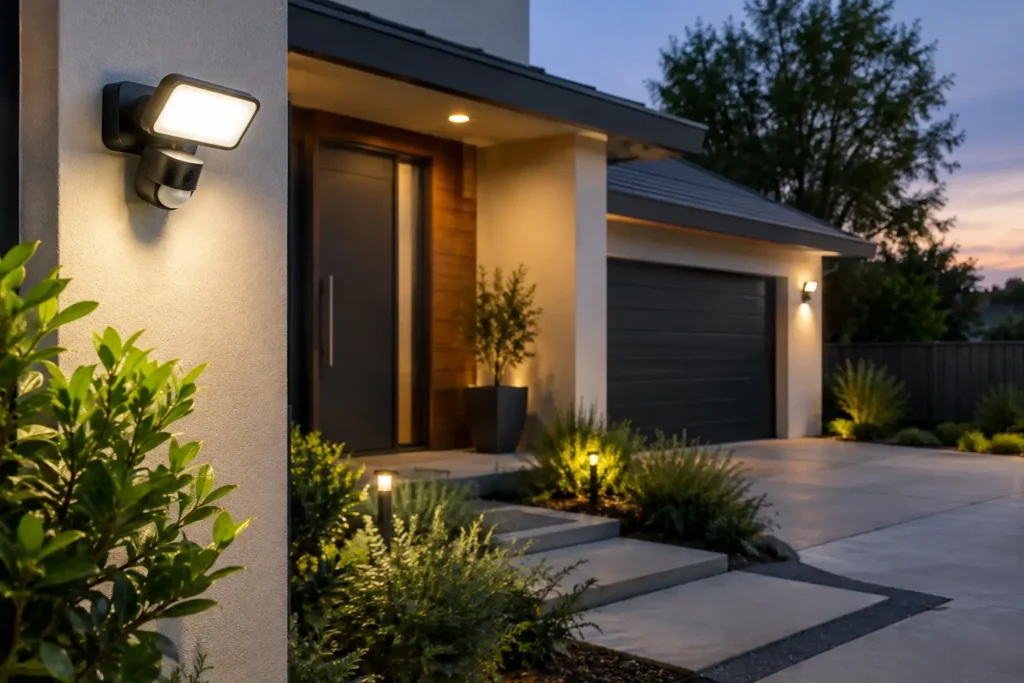
A dark side passage, an unlit rear entrance or a shadowed car park can make a property feel less secure than it is. Well-planned security lighting gives you a clear view of approaches, entrances and boundaries when it matters, without turning your home or premises into a floodlit site.
For homeowners, landlords and businesses, security lighting should be practical first. It needs to help people move safely, discourage unwanted visitors and make cameras more effective. The right installation is rarely about fitting the brightest light available. It is about putting suitable fittings in the right places, with controls that work reliably.
Plan security lighting around real weak points
Start by walking around the property after dark. You may quickly notice areas that are easy to overlook in daylight: a gate beside the house, the path from the drive to the front door, a side access route, a bin store or the rear door used by staff.
The front entrance is usually the first priority. A light here makes it easier to identify visitors, find keys and use the doorstep safely. Side passages deserve equal attention because they can provide concealed access to the rear of a property. At the back, cover doors, patio areas, sheds and gates without directing light into bedroom windows or neighbouring gardens.
For commercial premises, think beyond the building itself. Staff may arrive early, leave after dark or need to access loading areas, storage yards and parking spaces. Good lighting around these routes can reduce trips and falls as well as improve site security. The best layout depends on how the premises are used, when people are on site and whether cameras need a consistent level of light to capture useful footage.
Avoid trying to light every corner
More light is not automatically better security. A very bright fitting in one position can create deeper shadows nearby, making it harder to see what is beyond the lit area. It can also cause glare for drivers, pedestrians and neighbours.
A better approach is to use several carefully directed fittings to cover the important routes and entrances. Lower-level lighting can make paths and steps safer, while a sensor-controlled wall light can cover a doorway or side gate. This creates useful visibility without leaving powerful floodlights on all night.
Choose controls that suit the property
The control method has a big effect on how useful your lighting will be. A light that stays on unnecessarily wastes electricity and may become a nuisance. One that switches off too quickly or misses movement is equally frustrating.
Passive infrared, or PIR, sensors are a popular choice for domestic security lighting. They detect changes in heat and movement, then switch the fitting on for a set period. They are effective for front doors, driveways, side access and garden entrances, provided the sensor is positioned correctly.
Sensor positioning matters. A PIR is generally more responsive to movement across its field of view than movement directly towards it. Trees, washing lines, passing traffic and roaming pets can also trigger poorly positioned sensors. Sensitivity, range and run time should be adjusted after installation, not simply left at factory settings.
Dusk-to-dawn controls are often more suitable where steady light is needed, such as a shared entrance, business sign, car park route or communal path. A photocell turns lights on as natural light falls and off again in daylight. Timers can also work well for properties with predictable opening hours, although seasonal changes in daylight should be allowed for.
Some installations combine these controls. For example, low-level lighting may operate from dusk until dawn, with brighter lights at doors or gates activated only by motion. This can be a sensible balance between safety, security and running costs.
Pick fittings made for outdoor use
Outdoor fittings must be suitable for the conditions they will face. Rain, frost, dust, wind and changing temperatures can quickly affect a poorly chosen light or connection. The fitting needs an appropriate IP rating, which indicates how well it is protected against water and solid particles.
For many exposed external locations, an IP-rated fitting designed for outdoor use is essential. The required rating can vary according to where it is installed and how sheltered the position is. An electrician can advise on a fitting that is suitable for the location rather than relying on appearance alone.
LED security lights are normally the practical choice. They use less energy than older halogen floodlights, produce useful light quickly and typically have a much longer service life. They are available in a wide range of outputs, so a modest light near a front door and a stronger fitting over a larger driveway can be matched to the job.
Colour temperature is worth considering too. A very cool white light can feel harsh around a home, while a warmer white fitting may be more comfortable for entrances and patios. For commercial areas or camera coverage, the priority may be clearer visibility. There is no single answer, but the light should be bright enough for its purpose without causing glare.
Get the electrical installation right
An outdoor light is only as reliable as the circuit, cables and connections behind it. Permanent security lighting should be installed on a suitable electrical circuit with appropriate protection. External connections need to be correctly enclosed and cable routes must be protected from damage, whether they run through walls, along fences or beneath the ground.
This is particularly important when adding lights to older properties. An existing outside light may have been connected years ago, possibly with worn fittings, unsuitable cable or no effective protection against faults. If lights trip the consumer unit, flicker in wet weather or stop working intermittently, the problem should be investigated rather than covered up with a replacement fitting.
Where new cabling is required, the neatest solution is not always the safest or most cost-effective one. Concealed cables can give a tidy finish but may involve more work inside the property. Surface routes can be suitable in some garages, workshops and commercial areas when installed properly in protective containment. A site visit allows the options to be explained clearly before work begins.
Think about neighbours and wildlife
Security lighting should protect your property without causing problems beyond its boundary. Angle lights downwards and away from neighbouring windows, roads and public footpaths. Use shields or adjustable heads where needed, especially with floodlights mounted high on walls.
Constant light in gardens can also affect wildlife and disturb your own enjoyment of outdoor space. Motion controls, sensible run times and focused beams reduce unnecessary light spill. If a sensor is repeatedly triggered by cats or wildlife, adjusting its angle or detection range may solve the problem without reducing security.
Maintain the system after installation
Even quality fittings need occasional checks. Clean lenses and sensors gently so dirt and cobwebs do not reduce light output or interfere with detection. Test motion sensors after changing garden furniture, planting or fencing, as these alterations can affect the detection area.
Look out for water inside the fitting, cracked covers, loose brackets, corrosion or lights that remain on unexpectedly. Lamps that repeatedly fail, a buzzing fitting or a circuit that trips should not be ignored. These can point to water ingress, damaged wiring or a fault within the fitting.
Landlords and property managers should include external lights in routine checks between tenancies or as part of planned maintenance. Reliable lighting at shared entrances, refuse areas and access paths is a straightforward way to make a property feel safer and better cared for.
When to call an electrician for security lighting
Replacing a like-for-like, accessible bulb is one thing. Installing a new outdoor circuit, altering fixed wiring, fitting external switches or diagnosing a fault calls for a qualified electrician. This is especially true if the work involves consumer unit protection, underground cables, a metal-clad building or an area exposed to weather.
A professional installation also gives you the chance to discuss what you actually need. Eldred Electrical Services can assess access routes, existing wiring and the level of light required, then provide a clear, no-obligation quotation for suitable security lighting across Tonbridge and the surrounding Kent area.
The most effective security light is often the one you barely think about: it comes on when you arrive, clearly lights the route you need and gives you confidence that your property is not left in the dark.


