
How to Test Emergency Lighting in Your Premises
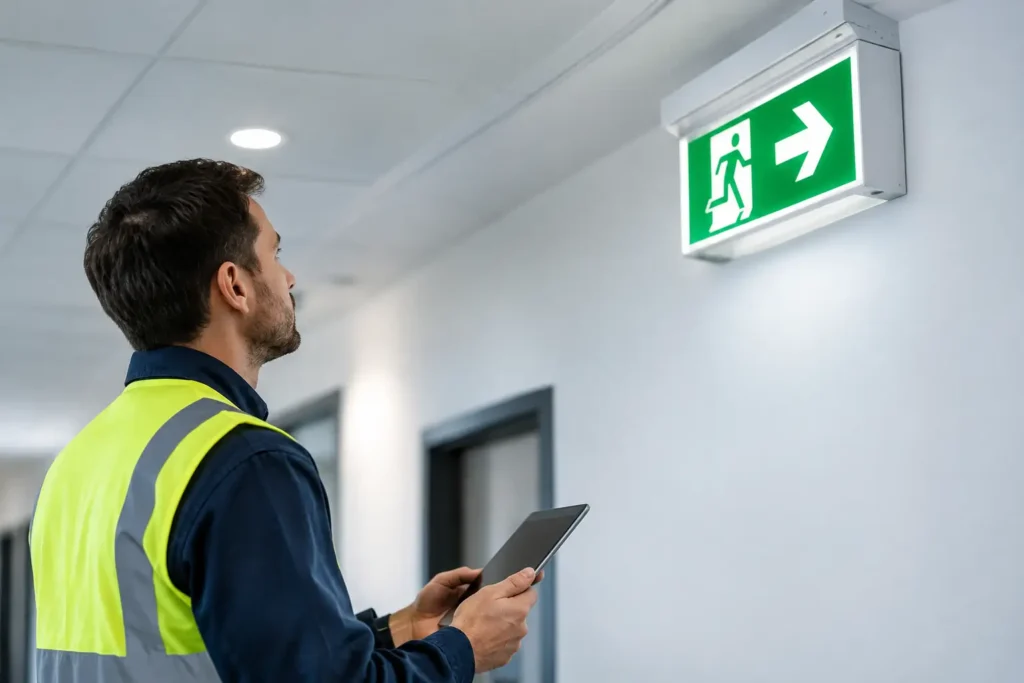
A power cut is not the time to find out whether the emergency lights in your workplace, communal hallway or commercial unit actually work. To test emergency lighting properly, you need to confirm that fittings switch on when the normal supply fails, stay illuminated for the required period and leave a clear record of the result.
For many premises in Kent, this is a straightforward routine when the system is maintained well. When testing is missed, batteries age, indicator lights are ignored or changes are made to the building layout, a system that looks fine day to day may not provide safe escape lighting when it is needed.
What emergency lighting testing checks
Emergency lighting is designed to operate automatically when the normal lighting supply fails. It helps people find escape routes, stairs, exits, fire equipment and open areas without relying on daylight or mobile phone torches.
A proper test is more than checking that a small green LED is lit. The LED generally shows that a fitting has power or that its battery is charging, but it does not prove the unit will provide light for long enough during a mains failure.
Testing should check that emergency fittings illuminate, that they are in the right locations, that signs remain visible and that batteries can support the required duration. In many non-domestic premises, emergency lighting is expected to run for three hours, although the correct duration and testing arrangement depend on the building, its risk assessment and the system design.
The person responsible for the premises should also make sure that changes have not compromised the coverage. A new partition, stock racking, altered office layout or blocked corridor can turn a previously suitable emergency light into one that no longer adequately covers an escape route.
How often should you test emergency lighting?
The usual approach follows the principles of BS 5266, alongside the building’s fire-risk arrangements and the manufacturer’s instructions. Your exact responsibilities can vary, particularly in mixed-use buildings, shared blocks and specialist workplaces, so it is sensible to seek advice where there is any doubt.
Monthly functional checks
A short functional test is normally carried out each month. This involves simulating a failure of the normal lighting supply for a brief period and confirming that every emergency light and illuminated exit sign operates.
The test needs to be long enough to confirm the fitting works, but not so long that the battery is needlessly discharged. Once normal power is restored, check that charging indicators return to their normal condition.
A monthly test is a useful opportunity to spot fittings that are damaged, obscured, dirty, flickering or incorrectly positioned. It is also a good time to check that exit routes have not become blocked by deliveries, furniture or stored materials.
Annual duration test
A full discharge test is normally carried out once a year. This checks whether the system can operate for its full rated duration. Because batteries may need time to recharge afterwards, the test should be planned carefully.
Do not carry out a long test just before the building is occupied, before an evening event or when there is a realistic chance of a power issue. During recharging, the emergency lights may not offer their normal level of backup. For businesses with extended hours, arranging the work around quiet periods can reduce disruption.
Larger premises may need a more structured programme. A professional inspection can identify the right test procedure, whether central battery equipment is present and whether fittings can be tested through an automatic system rather than by switching circuits manually.
A safe way to test emergency lighting
The right method depends on how your emergency lighting is wired. Some fittings are maintained and stay illuminated during normal operation. Others are non-maintained and only come on when the normal supply fails. There may also be self-contained units with individual batteries or a central battery system serving multiple lights.
If you are responsible for routine checks, only use the intended test key switch, test device or control panel. Do not isolate circuits at the consumer unit unless you understand exactly what else will be affected. A circuit may serve other essential equipment, security systems, refrigeration, computers or shared parts of a building.
Before starting, let people in the building know what is happening. Confirm that ordinary lighting is available where needed and take extra care around stairs, uneven surfaces and areas with no natural light. If the test causes any safety concern, stop and arrange a suitable time or ask an electrician to carry it out.
During the test, walk the escape routes rather than simply looking at a few nearby fittings. Check that light reaches stair treads, direction changes, fire exits, corridors and any area where people need to move safely. Exit signs should be clear and visible from the approach to the door.
When normal power is restored, inspect the fittings again. A unit that does not recharge, shows a fault indicator or remains dim should be investigated. Repeatedly resetting a failed fitting is not a repair.
Keep a clear emergency lighting test record
A simple logbook is valuable for landlords, businesses and property managers. It demonstrates that checks have been carried out, makes recurring faults easier to identify and gives an electrician useful information when attending site.
Record the date, the area tested, the test type, the result and any action needed. Note faults clearly, such as “rear corridor fitting did not illuminate” rather than simply writing “failed”. Include the date the fault was repaired and who completed the work.
If you manage a block of flats or a commercial building, keep the logbook with other fire-safety information where the responsible person can access it. The record should cover communal and escape-route lighting, not individual lights inside private flats unless they are part of the building’s emergency lighting design.
Common faults found during emergency lighting tests
Emergency lighting faults are often caused by components that slowly deteriorate rather than by a sudden wiring failure. Batteries have a limited working life and may charge enough to show an indicator light while no longer sustaining the lamp for its rated duration.
Older fittings can also suffer from failed lamps, damaged circuit boards, loose connections, worn test switches or water ingress. In garages, workshops and external access routes, dirt and moisture can reduce light output or damage enclosures. A fitting may illuminate but still be unsuitable if its diffuser is badly yellowed or cracked.
In some premises, the biggest problem is not the fitting itself. Building alterations can leave new rooms, changed routes or relocated fire exits without adequate emergency coverage. An electrician can assess the practical layout rather than simply replacing the nearest failed unit.
When to call an electrician
Routine brief checks may be manageable for a trained responsible person, but faults, annual duration testing and changes to an installation are better dealt with properly. Call an electrician if emergency lights fail to come on, fail to remain on for the required period, trip a circuit, show persistent fault indicators or have been affected by damp, impact or building work.
It is also worth arranging professional help when taking over a new commercial unit, converting part of a property, opening a shop or office, or managing a building with no recent records. The existing system may need testing, repairs or an assessment of whether it still suits the premises.
Eldred Electrical Services can inspect emergency lighting, diagnose faults and carry out repairs or replacement work for local businesses, landlords and property managers across Tonbridge and the surrounding Kent area. The aim is to explain what has been found clearly, keep disruption sensible and leave you with a safer, working installation.
Emergency lighting is easy to overlook because it spends most of its life waiting quietly in the background. A planned test and a properly recorded result give you far more reassurance than an indicator light ever can.


