
Socket Spur Versus Ring Circuit Explained
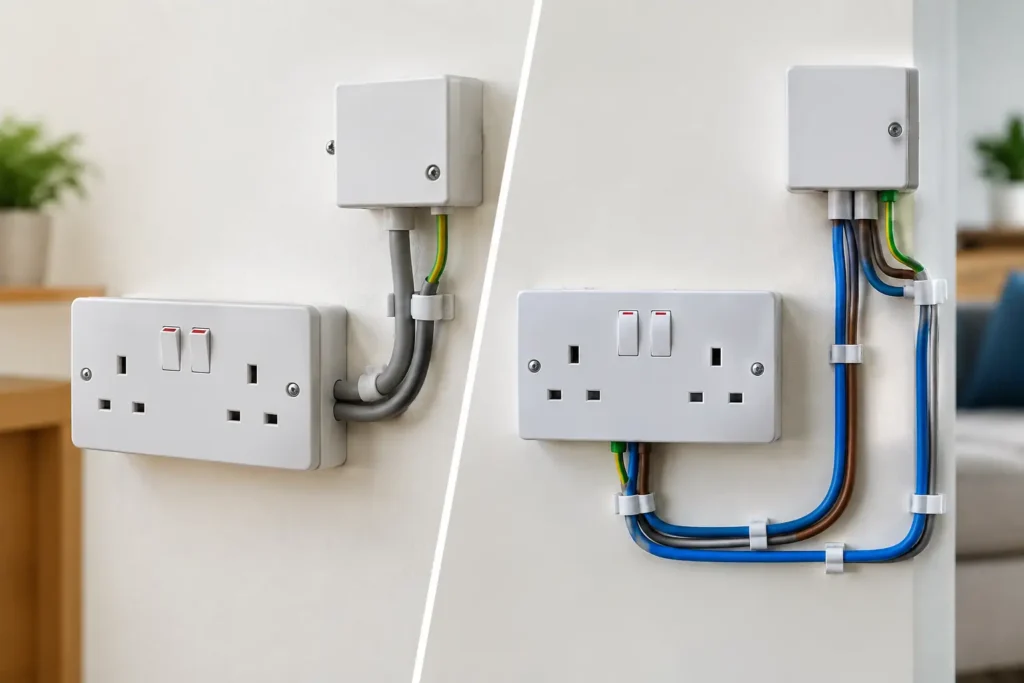
A new socket can look like a small job, but the way it is connected matters. The question of socket spur versus ring circuit usually comes up when a homeowner wants an extra outlet in a kitchen, bedroom, home office or garage. The right answer depends on the existing wiring, the expected load and whether the circuit can safely support the addition.
A spur is not really an alternative type of circuit to a ring circuit. It is normally an extension taken from an existing circuit, often a ring final circuit. Understanding that difference helps avoid overloaded wiring, nuisance tripping and unsafe alterations.
What is a ring circuit?
A ring circuit, more accurately called a ring final circuit, is a common arrangement in UK homes. The cable leaves the consumer unit, runs around a number of sockets, then returns to the same protective device at the consumer unit. This creates a complete loop or ring.
In many properties, socket rings are protected by a 32-amp device and wired in 2.5mm² twin and earth cable, although this should never be assumed. Older homes, extensions and altered installations can have very different arrangements. A circuit may be a radial circuit rather than a ring, may have different cable sizes, or may have been changed over the years.
The purpose of a ring is to distribute the load between two paths of cable. It is well suited to general socket use where appliances are plugged in at different points around a room or floor of a property. However, it still has a limit. Adding more outlets does not create more available capacity for high-load appliances.
That matters particularly in kitchens, utility rooms and offices. Kettles, microwaves, air fryers, tumble dryers, heaters and EV charging equipment can all place significant demand on an electrical installation. The number of sockets is not the only issue – the appliances being used at the same time are equally important.
Socket spur versus ring circuit: the key difference
A socket spur is a cable branch taken from an existing point on a circuit. It is commonly used where one additional socket is needed and extending the ring itself would be impractical or unnecessarily disruptive.
An unfused spur from a ring circuit can usually supply one single socket, one twin socket or one fixed appliance, provided the circuit design and cable installation are suitable. It must not be used to add a run of extra sockets or to create a second branch from an existing spur.
A fused spur uses a fused connection unit, often known as an FCU. The fuse in that unit limits the load supplied beyond it, commonly to 13 amps or less. This can be useful for supplying fixed equipment such as an extractor fan, boiler controls, underfloor heating controls or a small number of appropriately designed outlets. It does not mean that any arrangement beyond the fused spur is automatically safe. Cable size, installation route, appliance load and isolation requirements still need to be considered.
Put simply, a ring circuit is the main route serving a group of sockets. A spur is a carefully controlled branch from that route. Both can be useful, but they follow different rules.
When is a spur the sensible option?
A spur can be a neat and cost-effective solution when the need is straightforward. For example, you may want a single additional socket beside a television, an outlet for a wall-mounted display, or a socket in a cupboard for a router or broadband equipment.
It can also be useful when opening walls or lifting large areas of flooring to extend the original ring would cause unnecessary disturbance. A properly planned spur may allow an electrician to provide the outlet you need while keeping the work tidy and proportionate.
There are limits. A spur is not the best choice for a location likely to serve several high-demand appliances. It may also be unsuitable where the existing ring is already heavily loaded, where previous work has left the circuit difficult to verify, or where cable routes would place wiring in an unsafe location.
A kitchen is a good example of why an on-site assessment is worthwhile. One extra socket for a low-use appliance may be simple. A bank of new worktop sockets expected to run cooking equipment is a different job and may call for an extended circuit, a new radial circuit or a wider upgrade to the installation.
Why you should not rely on appearances
A socket front can be replaced or added without revealing how the circuit behind it is wired. It is not possible to confirm that a socket is on a ring, radial or spur simply by looking at the faceplate.
An electrician can test the circuit to establish its arrangement and condition. This includes checking continuity, earthing, polarity, insulation resistance and the operation of RCD protection where fitted. These tests help identify issues such as a broken ring, borrowed neutrals, poor connections or an incorrectly connected previous addition.
A broken ring is a particular concern. It may still appear to work normally, but the circuit may no longer share its load as intended. Adding a further spur before the fault is identified could make the situation worse.
This is why extending from the nearest socket is not always the right approach. The nearest point may already be a spur, may be part of a different circuit, or may not be suitable for the load you have in mind.
Common mistakes with socket spurs
The most frequent problem is a spur taken from another spur. This can leave too much wiring and too many outlets dependent on a single connection point, with a greater risk of overload or poor fault protection.
Another mistake is treating a twin socket as though it has the capacity of two separate circuit supplies. A twin socket on an unfused spur is still one accessory supplied by that spur. Plugging several extension leads into it does not increase what the wiring can safely carry.
Poor connections are another concern, particularly where DIY work or ageing accessories are involved. Loose terminals can overheat. Signs include a warm socket or plug, scorch marks, crackling, a burning smell, flickering power or repeated tripping. Stop using the affected socket and arrange for it to be checked promptly. If there is smoke, visible damage or an immediate danger, isolate the supply if it is safe to do so and seek urgent electrical help.
Is a new ring circuit ever better?
Sometimes the best answer is neither an ordinary spur nor an extension of an existing ring. A new circuit may be appropriate where an extension, converted loft, garden office, workshop or kitchen needs more capacity than the existing circuit can reasonably provide.
A radial circuit is also a valid option. Unlike a ring, it runs from the consumer unit out to the outlets and ends at the final point. When correctly designed, protected and tested, a radial can be an excellent choice for specific areas or known loads. The decision is based on electrical design, not on a one-size-fits-all preference for rings.
For landlords and business owners, this is particularly relevant where usage changes over time. A former storeroom can become an office full of monitors, chargers and heaters. A small retail area may gain refrigeration, displays or till equipment. The electrical installation should reflect how the space is actually used, not just how it was originally fitted out.
What a professional electrician will check
Before recommending a spur or a circuit alteration, a competent electrician will look at the consumer unit, circuit protection, cable routes, earthing and the likely load. They will also check whether RCD protection is present and appropriate, especially where cables are concealed in walls or serve areas with increased risk such as kitchens, bathrooms or outdoors.
Work should be completed and tested in line with the current requirements of BS 7671. Depending on the location and scope of the work, Building Regulations requirements may also apply in England. You should receive suitable certification for completed electrical work, giving you a record of what has been installed and tested.
For a simple additional socket, the assessment may be quick. For an older property, a consumer unit with no RCD protection, or a circuit with unexplained faults, further investigation may be the safer and the more honest recommendation.
Plan the socket around how you live
The best place for a socket is not always the closest point on the wall. Think about furniture, appliance leads, future use and the need to avoid trailing extension leads. In kitchens, consider where small appliances will actually be used. In bedrooms, allow for bedside lamps, charging and vacuum cleaning. In a home office, plan for monitors, routers and desk equipment without creating a tangle of adaptors.
A well-designed addition should feel simple once it is complete: enough outlets in sensible places, neat workmanship and confidence that the circuit has been checked properly. If you are considering extra sockets or are unsure about an existing spur, a qualified local electrician can assess the installation and explain the safest practical option in plain language.


